
Commercial Real Estate Asset Classes
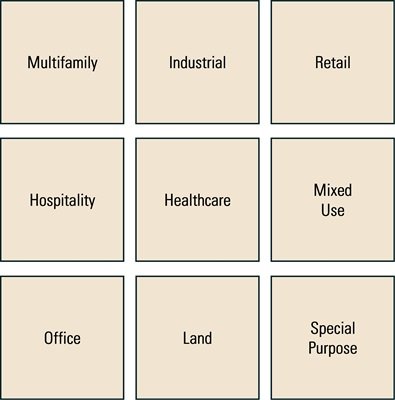
Multifamily
Multifamily properties fall under commercial real estate when they have five or more units. They predominantly rent to households and businesses. Performance is generally driven by employment and wage growth, with rental income predominantly from household tenants. Typically graded on overall desirability according to a Class A / B / C system. Common multifamily concepts include: Garden, Mid-rise, High-Rise, Student Housing, Senior Housing, Affordable Housing, Co-living and Build-to-rent.
Industrial
Industrial properties typically have corporate tenants, and are used for manufacturing, storage, logistics, and research. Performance is generally driven by commercial business activity and supply chain dynamics, with rental income predominantly from commercial tenants. Typically graded on overall desirability according to a Class A / B / C system. Common industrial concepts include: Manufacturing, 3PL facilities, Warehouse, Last Mile, Flex Space, Cold Storage, Data Centers, and Showrooms.
Retail
Retail properties house businesses that sell goods and services directly to consumers. They can be standalone or part of larger centers. Performance is generally driven by consumer foot traffic, with rental income predominantly from commercial tenants. Typically graded on overall desirability according to a Class A / B / C system. Common retail concepts include: Strip Malls, Community Centers, Power Centers, Lifestyle Centers, Power Centers, Regional & Super Regional Malls, Outlet Centers, Freestanding Retail
Hospitality
Hospitality real estate consists of properties that provide lodging and entertainment services. Performance is generally driven by travel related activities (e.g. business travel and tourism), with individual and business-related guests. Common hospitality concepts include: Hotels, Resorts, Short-Term Rentals
Healthcare
Healthcare real estate includes medical facilities that serve patients and healthcare providers. Performance is correlated to a combination of patient volume and healthcare reimbursement methodology. Common healthcare concepts include: Hospitals, Medical Office Buildings, Surgical Centers & Clinics, Urgent Care Centers, Skilled Nursing Facilities, Behavioral Health Centers
Mixed-Use
Mixed-use properties combine two or more real estate asset types in a single development. Performance is correlated to underlying asset types. Common mixed-use concepts include: Vertical Mixed-Use, Horizontal Mixed-Use, live-work-play communities.
Office
Office buildings house businesses and professional services. They vary in class and layout. Performance is correlated to tenant driven considerations, hybrid work adoption rates, commute patterns, and local business formation trends. Common office types include: Central Business District, Class A/B/C, Suburban Office Parks, Co-working Centers
Land
Land is a broad real estate category that includes undeveloped and partially developed parcels. Land is often valued as a financial option, and driven often by zoning requirements, transportation access, utility availability, environmental regulations, construction costs, and regional employment and business formation trends. Key land types include: Infill Land, Greenfield Land, Brownfield Land, Agricultural Land, Timberland
Special Purpose
Special purpose real estate consists of properties that do not fit into traditional CRE categories due to their unique design or usage. Performance is tied to their specific purpose. Common concepts include: Religious Facilities, Schools & Educational Facilities, Entertainment Venues, Self-Storage, Gas Stations, Government Buildings, Funeral Homes,

Invest with Us
Reach out to learn about our investment opportunities or to stay up to date on our latest offerings.